1 - Art, Film & Truth
By: Helena Kolovos, Emilie Dillon, Jake Assouline, Tyler Boulay
Waltz With Bashir

Film, art and truth are extensions of the same idea. They can reveal what is hidden oftentimes in plain sight. However, the truth can be easily skewed and as a result, hard to find. This can be a result of art and film being biased. The animated documentary film Waltz with Bashir shows how memory is an unreliable source for the truth, which can also affect the film’s credibility as a whole. In this film, Ari Folman goes on a mission to find his lost memories of happened during his time in the Lebanon War. The film Stories We Tell also reflects how the truth can be changed and as a result more difficult to find. A woman embarks on a journey to figure out what kind of a person her mother was, even though the person she finds and recreates might not exactly be her mother as she was.
Documentaries are vital for society to acquire knowledge on events/topics that we otherwise wouldn’t be able to explore. They allow us to learn and form opinions about these situations from a safe distance. Although being able to observe from a safe distance is convenient, it can put the truth of the film at risk. Some risks may include a biased filmmaker without the viewer knowing, or a misinterpretation of material. The viewer doesn’t know what’s going on beyond the television frame. Truth is apparent in most documentaries, because that is the main goal of the film maker. The point of a documentary is to inform the population about the truth of a certain situation. Truth, meaning objective collection of facts. We see plenty of evidence in the film “Waltz with Bashir”, as the main theme of the whole film is questioning the reliability in our memories to deliver the entire truth.
Film and art tie in together to form a vital part of a documentary success. The art of filmmaking can mean the difference between a poorly delivered topic and a professional presentation of a topic. The structure of the film must be completed in an artistic way to appeal to the audience in order to be successful. Within the crucial structure of the film is providing the viewer with enough material necessary to show all possible perspectives on the topic, and enough material to help us make our own perspective. Perspective is a matter of how the viewer sees the topic. If the documentary doesn’t obtain enough information the viewers will have limited access to perspective. This is a paradox because perspective can be used and perceived in many ways. The tricky thing with this paradox is that while the filmmaker tries to feed the viewer with as many possible paradoxes, there will always be one missing therefore a lack of a certain perspective.
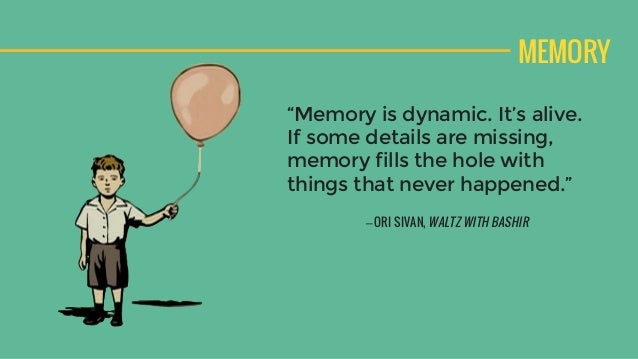
Documentaries are known as an intentional form of communication. The communicator being the filmmaker or people being affected by the topic. The purpose of the communication is often to show people the truth and perspectives, as mentioned previously. The communication within a documentary is truly successful when the viewer is triggered by some sort of emotion. This is a very interesting reaction from an audience, because it meant that the film was so well made that the viewer truly felt involved and a form of sympathy for the events being documented. For example, in “Waltz with Bashir” the main emotion the filmmaker plays with is sadness. When the viewer comes to a point where they feel sad, the intention is immediately successful because a sense of humanity has been acquired from the audience. The communication creates meaning.
The final most important concept present in documentary films is that of knowledge. The main reason one watches a documentary is to obtain knowledge on a topic. Documentaries typically both contain and pass forward knowledge. Contain, because the information and content in this film genre is straight knowledge. The thought process involved in providing so much knowledge through film is breathtaking. The content must fully cover all aspects of knowledge on the topic to be able to confidently pass on the knowledge on the viewer.
Knowledge is one of the most important aspects of human nature, and with the help of documentary films knowledge can be passed on more frequently and with more quality.
The Documentary
“Waltz with Bashir” is an animated documentary film that follows Ari Folman as he is searching for his lost memories of when he was an IDF soldier during the Lebanon War. Ari interviews people of their war experiences as they might help him remember what he had done and where he had been as a 19-year-old IDF infantry soldier during the war. Ari constantly has visions of when he was in Beirut during the massacre, which only become fully clear in his mind at the very end of the film.

Documentaries allow us to learn and form opinions about events/topics from a safe distance, which can lead to the questioning of the film’s credibility. The documentary film “Waltz with Bashir” is no exception to this, and it can even be said that it is slightly more questionable than most documentaries because the film is animated. However, the animation doesn’t make the film completely untrustworthy since he still interviews people and their stories are most likely to be true, but it’s the depiction of these stories through this medium that can be questioned as the footage to go with the stories is how Ari visualizes them. This in turn causes the film to be very subjective. A specific example of this is the story of a soldier who had a hallucination of a giant naked woman who comes out of the ocean and saves his life from an explosion. Ari was able to show this with the use of animation which is very creative, but what happened exactly in this scenario isn’t clear since it blended a hallucination (giant woman) and a fact (the explosion).

The use of animation in “Waltz with Bashir” is extremely effective. It emphasizes the fact that memory is unreliable since real footage is more reliable for being able to visualize clearly the events that occurred. With animation, he was able to play with the depiction of these events and this form of art is a key selling point of the film. Ari Folman never seems to remember anything clearly throughout the film where animation is used, but at the very end of the film, real footage is used that shows the Palestinian refugees who suffered and this has a huge emotional impact on the viewers.
Documentaries are known as an intentional form of communication, which is used to trigger emotions which then causes the viewers to react to the film. In “Waltz with Bashir”, Ari Folman depicts many scenarios that can trigger many emotions, but he focuses mainly on the emotion of sadness. For example, the revelation of the people inside the car that the IDF soldiers shot causes the viewers to feel sadness, as it turns out they were not hostiles and it was just a family. This film just tells the events that occurred, it doesn’t necessarily try to brainwash people into believing the filmmakers’ perspectives. This causes people to get involved by forming their own opinions on certain aspects of the film. With the example of the family in the car, many viewers may say that the IDF soldiers were overly hostile while others may say that the IDF soldiers were just being very cautious.
Documentary films give knowledge on events/topics that may otherwise be unexplored. It is contained in the film and it is then passed onto the viewer when they watch the film. In “Waltz with Bashir”, Ari Folman passes on knowledge regarding the Lebanon war. Facts are not a heavily enforced factor in this film. Knowledge is passed on by the different war stories, but the film is not perfect for helping the viewers understand the war since it is very limited to the views of the people that are telling their own experiences.
Stories We Tell

In the film Stories We Tell Sarah Polley seeks to figure out what sort of person her late mother was by interviewing the people who surrounded the woman during her life. The story begins on the second chapter of her life, the filmmaker having deciding to reveal information much like in the way she figured it out the first time.
Her parents meeting, eventually getting pregnant with the filmmaker herself. This was all initially presented as if they were an entirely functional family, when of course this was not the case. Diana, Sarah’s mother original wanted an abortion, but later decided not to. Diana loses the battle with cancer only a few years later, leaving many unanswered questions that were only raised years after that when it was pointed out that Sarah looked nothing like her father Michael. This intrigue grew, becoming at first a family joke and then stretched so far it was no longer a joke.
Three of the actors that Diana had worked with had became suspects in the ‘who's your daddy?’ case and Sarah eventually decided she would figure it out. The first actor and the primary suspect was Jeff Bows, who revealed these rumors to be false. Sarah later meets up with Harry Gulkin, hoping that he’d be able to give her more information on Jeff. This turns out to be extremely unlike what she expected as Harry admits to possibly being her father.
Harry explains the affair to Sarah, seeing Diana at in her role at the Centaur theater in Montreal and how she showed up at the same bar he was at not long after. They met up every night and were incredibly obvious in their affair. A genetic test is done, and Harry did end up being her biological father.
The film continues with Sarah’s and then later Michael's reaction to the news. Instead of being horrified, Michael is instead becomes obsessed with writing down the story. There became a focus on whether or not for the story to become published which created friction between Sarah and Harry. A journalist somehow gets ahold of the story and wants to publish it, but Sarah begs him not to. The remaining duration of the documentary relays Sarah’s process of figuring out the method in displaying the truth.
 Truth is explored, and creates friction between Harry and Sarah. “One does not get the truth, simply by hearing what their reactions are.” Harry tells Sarah. He openly disagreed with Sarah’s decision by interviewing everyone involved, and not simply his story from his point of view.
“The truth about the path is often ephemeral and difficult to pin down.” Was Sarah’s response, choosing instead to instead give the audience the truth from everyone involved, however diluted or changed by their unique perspectives it was.
“The crucial function of art is to tell the truth.” Harry said. This related to how three of the parties involved, Sarah, Harry and Michael all chose to use art to tell their story from the events. Both Harry and Michael write out their stories, for Michael it’s the first story he’s wanted for write for a long time. Sarah chooses film, and through her film she expressed the truth through her art. But what is the truth, exactly? The final few minutes of the film, Sarah reveals that those ‘dated films’ of her mother weren’t actually real, but were instead faithfully recreated productions using an actress to play her mother. Are they still truth? Or has the truth been lost and this documentary only shows a portion of what was?

Reflection
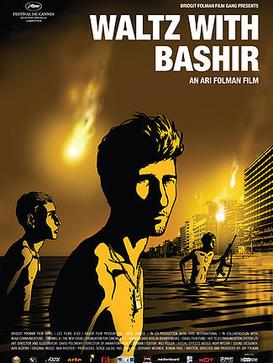 Just like any documentary, Waltz With Bashir brought up some very interesting and important topics that everyone in our group were able to agree upon such as the reliability of our memories, the truth behind the film, and the art that is the documentary. Both films played with our memories and the truths that people were supplying us with, and the films themselves and the meaning behind the reason they were created.
We are often sheltered from the real and terrible events that happen all around the world. In the case of Waltz With Bashir, our main character Ari is conflicted with his memories not sure what really happened during his days in the Lebanon war. As we know he asks others to fill his memories with their stories. Stories We Tell is filled with stories from different point of views from people in our director Sarah Polley’s life. In a way both documentaries are enhancing their knowledge on what exactly had happened in their and/or other people’s lives. We can follow in the footsteps of Ari and Sarah, by discovering things through other people’s point of view.

But the truth can be altered when hearing it from the word of mouth. We cannot take what everyone says as cold hard facts. Many opinions and ‘truths’ can be biased and not always an accurate source of information. To know ourselves is not through other people’s stories of us. As well as the stories of the world are not always as they seem. Through films the truth could be twisted and turn one sided. Hollywood tends to either leave out the important parts or exaggerate on the truths.
 Watching Waltz With Bashir brought up some very interesting and diverse memories in our team. This summer one of us in the team had done a Europe trip with family last summer. Three days after leaving Turkey, the 2016 Turkey coup d’etat happened. The country was on complete lock down. It was peacefully and all of a sudden was a country filled with distress and wreckage. Sort of like how all of a sudden these young males were put into a war that they weren’t prepared for. No one is ever ready for pain or wreckage. Although the coup d’etat is not even close to comparing to the bloodshed and pain that occurred to Ari, we still relate to the aspect of unforeseeable events.
We have a competitive gymnast on our team that had fractured their spine and had to undergo surgery as well as a back brace for six months. During those months our team mate had gone through serious trauma, going from 20 hours a week in the gym practicing to doing nothing and not being able to do what they love. Our team mate says they do not recall the six months that followed their accident. Not sure what they did as a pastime, and saw those months as just one big blur. Relating back to Ari and his memory gaps, our team member felt a kind of trauma and dealt with the same confusion of the past just like him.
There are also people in our team who had tonsil surgery. Being put under anesthetics, they described the surgery as a painless nightmare that they couldn’t do anything about. Similar to how Waltz With Bashir started off with Ari and one of his bad nightmares.
As a team, we could all agree that Waltz With Bashir was a documentary that we could admire that it opened our eyes on what had happened in Lebanon and in what way it affected those who participated. We couldn’t relate to exactly what had happened throughout the documentary but we were definitely moved by the film, but as well as brought up some personal experiences that we could link to the documentary with. Although we usually associate animation with imagination, this documentary tricked our brains and left us with feelings of empathy. We all thoroughly enjoyed the documentary and admired the use of animation but as well as the real life scenes we were struck with at the end.
